
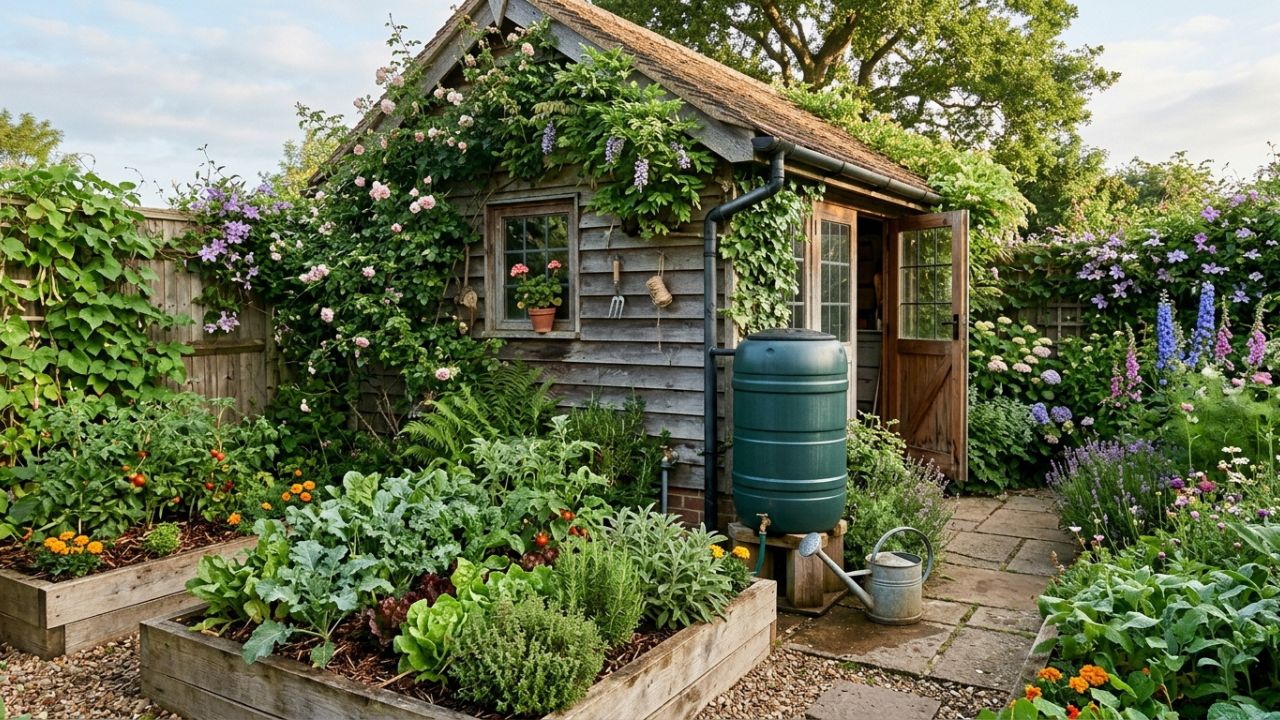
Anyone who is trying to live a greener life eventually starts looking at their garden hose with a bit of guilt. Municipal water is treated, pumped, and delivered at a real environmental and financial cost, yet so much of it ends up on lawns and flower beds that could just as easily be watered with rain that falls for free.
Collecting and storing water for garden use is one of the simplest ways to shrink a household’s footprint while also building a bit of resilience against dry spells, water restrictions, and rising utility bills.
The good news is that water harvesting has become far more approachable than it used to be. It is no longer just a giant barrel bolted to a downspout. There is now a whole range of products designed to fit small balconies, sprawling backyards, and everything in between. This article looks at ten of the most useful water collection and storage products for gardeners who want to make the most of every drop that falls from the sky.
Why Collecting Rainwater Matters
Before getting into the products themselves, it helps to understand why this practice is worth the effort. Rainwater is naturally soft, free of chlorine and other treatment chemicals, and slightly acidic, which many plants actually prefer over tap water. Collecting it reduces stormwater runoff, which in turn lowers the risk of local flooding and keeps pollutants from washing into rivers and streams.
It also cuts down on the demand placed on treatment plants, which use energy and chemicals to make water safe to drink, even though most of that water is not going into anyone’s mouth when it lands on a garden bed.
There is also a personal benefit. Households that collect their own water often see noticeable savings on their water bills during the warmer months when outdoor watering spikes. For gardeners in areas with seasonal droughts or watering restrictions, having a private reserve can mean the difference between a thriving garden and a wilting one.
What to Consider Before Buying
Choosing the right water collection and storage products depends on a few practical factors:
- The size of the roof or catchment area, since a larger roof collects more water per rainfall
- Available space for storage, whether that is a tight side yard or an open field
- Local climate and how often it rains
- Whether the water will be used for hand watering, drip irrigation, or both
- Budget, since prices range from a few dollars for a simple diverter to several hundred for a large tank system
With those factors in mind, here are ten products worth considering.
1. Rain Barrels
Rain barrels remain the classic entry point into water harvesting, and for good reason. They are affordable, easy to install, and widely available in sizes that suit most home gardens. A typical rain barrel connects to a downspout and holds anywhere from 40 to 80 gallons of water. Many modern versions come with a spigot near the bottom for filling watering cans and a secondary outlet near the top for connecting a soaker hose.
Rain barrels work well for smaller gardens or as a starter system before scaling up to something larger. Some gardeners link two or three together using a diverter kit to increase total capacity without taking up much more space.
Tips for Getting the Most from a Rain Barrel
- Elevate the barrel on a sturdy stand to increase water pressure at the spigot
- Add a mesh screen at the inlet to keep out leaves and mosquitoes
- Empty the barrel periodically so it does not become stagnant
2. Large Capacity Water Storage Tanks
For anyone with a bigger property or a serious vegetable garden, a large capacity storage tank is worth the investment. These tanks can hold anywhere from a few hundred to several thousand gallons and are usually made from food-grade plastic or reinforced polyethylene. They are often placed on a concrete pad or gravel base to keep them stable and level.
Large tanks are ideal for those who want enough stored water to get through an extended dry spell without needing to touch the municipal supply. They pair well with a pump system for distributing water across a large garden or small hobby farm.
3. Downspout Diverters
A downspout diverter is a small but mighty accessory that redirects rainwater from a gutter downspout into a barrel or tank instead of letting it drain away. Many diverters include a filter to catch debris before it enters the storage container, and some automatically redirect excess water back into the downspout once the storage container is full, preventing overflow and backups.
This product is especially useful for gardeners who already have gutters installed and simply want an easy way to start capturing what would otherwise be wasted runoff.
4. Rain Chains
Rain chains offer a more decorative alternative to a traditional downspout. Instead of water rushing down a closed pipe, it travels visibly down a chain of linked cups or links, creating a calming visual and audible effect during storms. While they are partly ornamental, rain chains can be directed straight into a barrel or basin below, making them a stylish way to combine function with garden aesthetics.
They work particularly well for gardeners who want their water collection system to feel like part of the landscape design rather than a purely utilitarian add-on.
5. Underground Cisterns
For those who want to store a large volume of water without sacrificing yard space, an underground cistern is worth considering. These tanks are buried beneath the lawn or garden bed and connected to a pump for retrieval. Because they are hidden from view, they do not interfere with the visual appeal of a garden, and their underground placement keeps the water cooler, which helps reduce algae growth.
Underground cisterns require more upfront installation work, often including excavation, but they offer some of the highest storage capacities available for residential use.
6. Collapsible Water Storage Bladders
Water storage bladders are a flexible, space-saving option for gardeners who do not have room for a rigid tank. These are essentially large, durable pouches that can be filled with water and tucked into crawl spaces, under decks, or along fence lines. When empty, many models can be folded flat and stored away, which makes them a good seasonal solution.
They are especially popular among gardeners in regions with irregular rainfall who want flexible storage that can expand or shrink based on need.
7. First Flush Diverters
The first bit of rain that washes off a roof usually carries dust, bird droppings, and other debris that accumulated during dry weather. A first flush diverter is designed to capture and discard that initial flow before allowing cleaner water to pass into the storage system. This small addition significantly improves water quality, which matters if the collected water will be used on edible plants.
8. Gravity Fed Watering Kits
Once water is collected, it needs a way to get to the plants. Gravity fed watering kits use the natural drop in elevation from a raised tank or barrel to slowly deliver water through hoses or drip lines without needing electricity. These kits are a favorite among gardeners focused on low-tech, low-energy solutions, and they pair beautifully with raised beds or container gardens.
9. Solar Powered Water Pumps
For gardens where gravity alone will not cut it, a solar powered water pump offers a way to move stored water without adding to electricity bills. These pumps use a small solar panel to charge a battery or run directly during daylight hours, powering drip irrigation systems or sprinklers from a rain barrel or tank. They are a natural fit for anyone already committed to a low-carbon lifestyle, since they avoid drawing power from the grid entirely.
10. Rain Gauges and Smart Monitoring Devices
While not a storage product in the traditional sense, a rain gauge or smart water monitor helps gardeners understand exactly how much rainfall their property receives and how full their storage tanks are at any given time. Some modern versions connect to a phone app and send alerts when a tank is nearing capacity or when rain is expected, allowing for better planning around irrigation schedules.
Comparing the Options
The table below offers a quick side-by-side look at how these products stack up in terms of typical cost, capacity, and best use case.
| Product | Typical Capacity | Best For | Relative Cost |
|---|---|---|---|
| Rain Barrel | 40 to 80 gallons | Small gardens, beginners | Low |
| Large Storage Tank | 300 to 5,000+ gallons | Large gardens, hobby farms | High |
| Downspout Diverter | N/A (accessory) | Existing gutter systems | Low |
| Rain Chain | N/A (decorative) | Aesthetic-focused gardens | Low to Medium |
| Underground Cistern | 1,000 to 10,000+ gallons | Space-limited yards | High |
| Collapsible Bladder | 100 to 1,000 gallons | Seasonal or flexible use | Medium |
| First Flush Diverter | N/A (accessory) | Edible gardens, water quality | Low |
| Gravity Fed Kit | N/A (accessory) | Raised beds, container gardens | Low |
| Solar Water Pump | N/A (accessory) | Off-grid irrigation | Medium to High |
| Rain Gauge or Monitor | N/A (monitoring tool) | Planning and efficiency | Low |
Getting Started Without Overwhelm
It is easy to look at a list like this and feel like an entire system needs to be built overnight. In reality, most successful water harvesting setups start small. A single rain barrel connected to one downspout is often enough to notice a difference in both water bills and garden health. From there, additional products can be added gradually as needs grow, whether that means a bigger tank, a solar pump, or a monitoring system to keep everything running efficiently.
Gardeners who are serious about sustainability often find that water collection becomes something of a gateway habit. Once the satisfaction of watering plants with free, chemical-free rainwater sets in, it becomes hard to go back to relying entirely on the tap.
Final Thoughts
Collecting and storing rainwater is one of the most practical steps a household can take toward a more sustainable lifestyle. It reduces strain on municipal water systems, lowers utility costs, and gives plants access to water that is often healthier than what comes out of a hose.
With options ranging from a simple barrel under a downspout to a fully buried cistern with a solar powered pump, there is a solution suited to nearly every garden size, climate, and budget. Starting with even one product from this list is a meaningful step toward a garden that relies a little less on the grid and a little more on the sky.



